

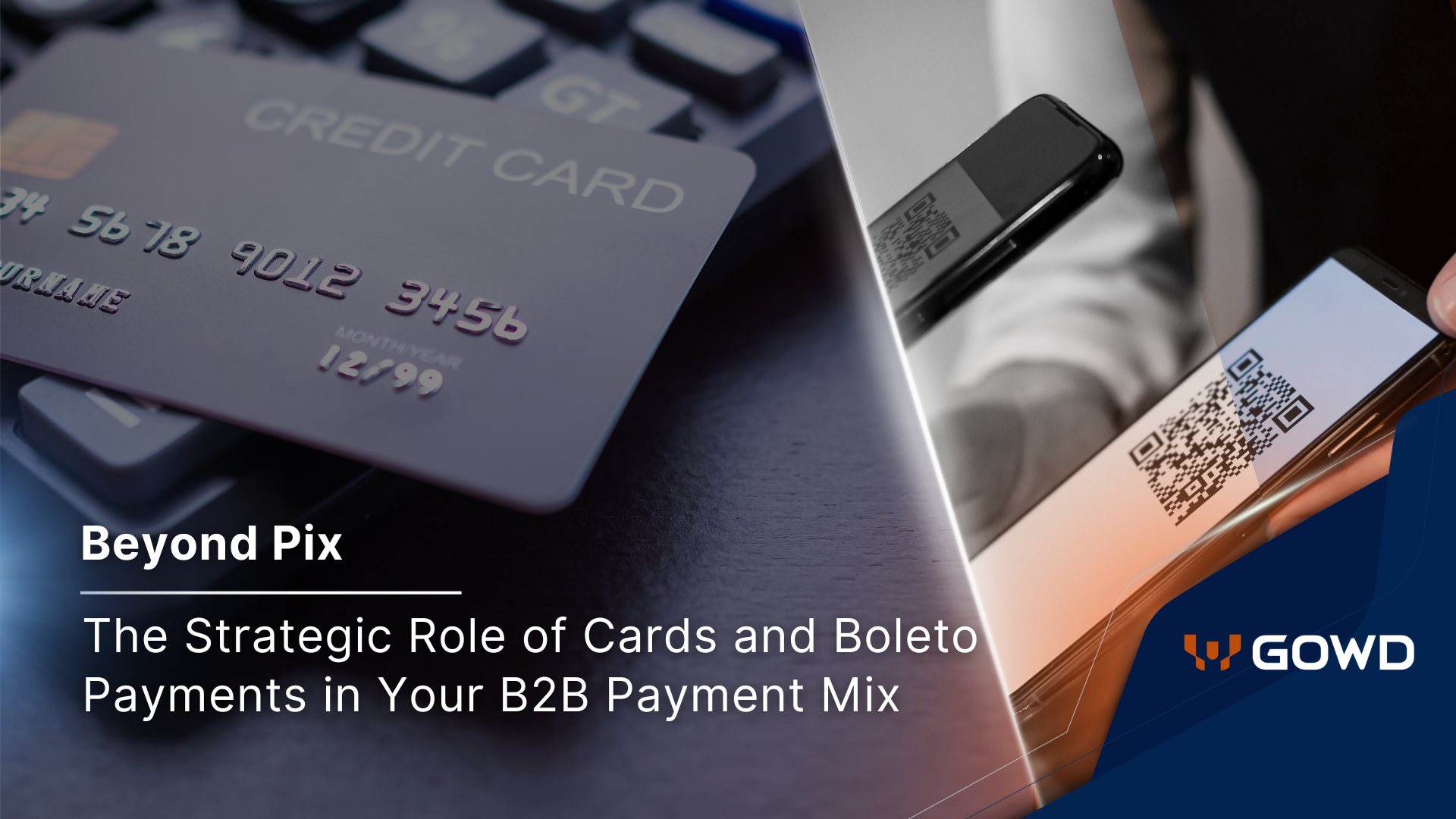
Pix has transformed payments in Brazil. Fast, available 24/7, and widely adopted, it has redefined the country’s financial experience.
But there’s an important point many companies overlook: building a strong B2B operation does not mean relying on a single payment method.
While much of the market focuses solely on Pix growth, billions in transaction volume are still processed daily through cards and boletos, especially in more complex, recurring, or financially structured B2B operations.
Companies that understand this stop viewing payment methods as “alternatives” and start treating them as part of their operational strategy.
The B2B Market Requires Financial Flexibility
In retail, speed is usually the priority. In B2B, the logic is different, many companies still depend on:
- payment terms;
- financial reconciliation;
- recurring billing;
- installment payments;
- internal financial approval processes.
This is exactly where cards and boletos remain highly relevant.
Boletos continue to play an important role in corporate operations by supporting financial workflows, accounting routines, and deferred payments.
Meanwhile, cards have gained traction across recurring business models, SaaS platforms, marketplaces, and digital services, offering greater predictability and operational flexibility.
The Problem with Relying on a Single Payment Method
When a company operates exclusively with Pix, it inevitably limits the portion of the market it can serve.
In practice, this can lead to:
- lower conversion rates;
- operational friction;
- reduced commercial flexibility;
- expansion challenges.
That’s why more mature operations rely on an intelligent payment mix, allowing different customer profiles to use the method that best fits their financial reality.
The Future Is Integration
The market is not moving toward “Pix versus boleto.”
The strongest scenario is the integration of multiple payment methods.
Pix, boletos, and cards each serve different roles within the financial journey of businesses and users. Companies that can efficiently integrate these layers build operations that are more scalable, predictable, and resilient.
In this environment, companies operating in Brazil and across Latin America need infrastructure capable of integrating multiple payment methods efficiently, at scale, and in compliance with local regulatory requirements.
GOWD operates precisely at this intersection, supporting crypto companies and digital platforms in building financial operations that are more connected to the region’s payment ecosystem — integrating local payments, segregated accounts, and operational flows designed for the diverse needs of the B2B market.
As a Payment Institution authorized by the Central Bank of Brazil, GOWD helps companies structure operations that are more connected to the local financial system, delivering greater predictability, scalability, and efficiency for growth across strategic markets in the region.
Learn how GOWD supports crypto operations with local financial infrastructure: